 George Harper
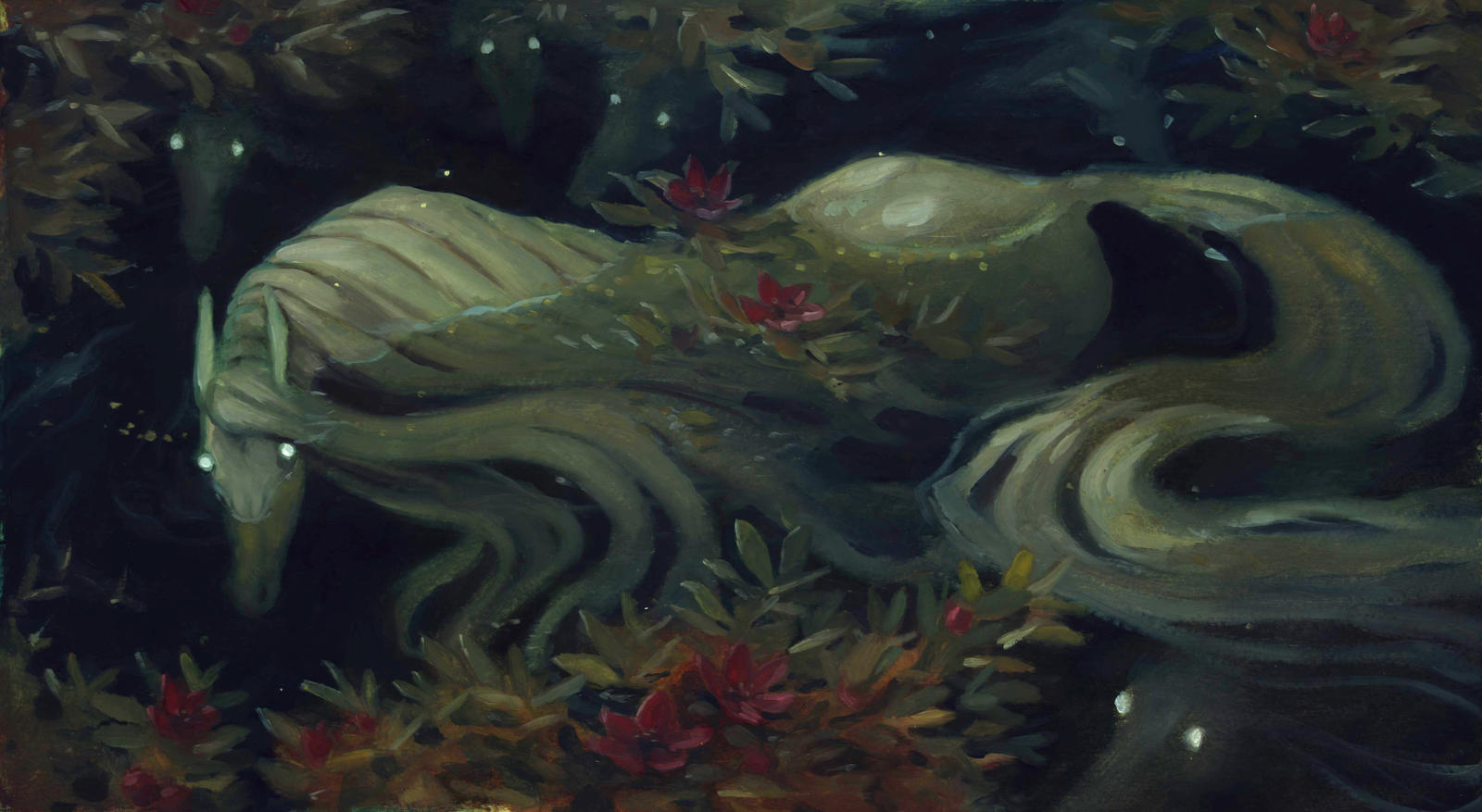
It’s advisable not to touch strange horses. They’re large animals with the mentality of a car that has been given the ability to feel fear, and if they decide they don’t like you, you probably aren’t winning that fight. In general, they behave like herbivorous motorcycles driven by a perpetual sense of road rage, and anyone who works closely with them can easily tell you that they are not to be trifled with. While this article is in no way meant to disrespect horses, it should go without saying that in Scottish folklore, they get even worse. Meet the kelpie, a dangerous water creature that presents itself in equine form and stands by bodies of water looking pretty so that passerby will jump onto its back, at which point it rushes into the water and drowns them as its next meal. In many depictions, it takes the form of a beautiful black or white horse with a flowing mane and tail (and backwards hooves) when on land, but becomes a black and slimy lake monster in the shape of an equine with sharp teeth upon contact with water. The nature of the creature makes it iconic to Scotland’s mythology, perhaps second only to Nessie.
In many tales, the kelpie hides sharp fangs and sticky skin beneath its ethereal outer layer when on land. Those who touch it in any way, shape, or form are stuck fast, dragged under, and torn apart. It’s safe to say that after getting involved with it, there is very little escape. Fortunately, kelpies fall under the folkloric umbrella of Faeries, and like the countless other Fae creatures depicted all across Celtic mythology play by a few set rules.
To begin with, it’s possible to tame this beast – at least for a little while. Several legends about the kelpie state that if one can put a bridle on the creature’s head, it is obligated to do whatever they tell it to. However, this murderous aquatic horse also tends to be sapient in nature, and is fully capable of holding a grudge against and attacking the one who took its autonomy once the bridle is removed again. Once upon a time, at Inverugie Castle, a man supposedly ran across a massive black horse. Upon realizing it was a kelpie, he managed to throw a bridle over its head, effectively capturing and subduing the creature long enough to make it carry the stones for the building of a nearby bridge. Only after that did he set it free, and from that day forward told his sons of the kelpie’s hard work whenever they complained about a long day of labor. Whether or not it ever sought revenge remains unknown, but the idea that it might not have makes it one of the calmest examples of a kelpie in any folktale.
More often than not, the kelpie is much more unpleasant and even downright malevolent. In another tale, eight little children weren’t so lucky. For those raised in Sutherland – like many other places where kelpies were a present part of the culture – this story was one of many that were told to warn kids away from the water while they played. As the story goes, eight children merrily skipped down to the lake one Sunday, too curious about the mysterious horse from their mothers’ tales for their own good. Playing in the shallows, they heard the sound of hoofsteps coming gently towards them, and turned around to see what it was with mixed curiosity and fear. There stood a majestic stallion, who knelt down so that the unsuspecting children could clamber onto its back. It got longer with each one, disturbingly extending its back to accommodate each rider. Only one boy refused to climb on. Unable to resist touching it but terrified by all the kelpie legends his mother had ingrained into his mind by then, he reached out and poked the strange horse with one finger. Instantly, he realized he was falling under the creature’s spell, and grabbed a little knife he kept in his pocket, which he used to cut off his finger and escape. The frustrated beast roared, reared up, and galloped off into the water with his finger and the seven other kids.
For the next story in this article to make sense, a little bit more information on the kelpie and its abilities is needed. Surprisingly enough, many legends state that kelpies are able to transform into humans, particularly men, whose only distinguishing feature from a normal person is the (usually very small pieces of) seaweed or lakeweed stuck in their hair. One day, a servant girl went down to a lake with a farmer’s herd of cattle to watch them while they grazed. She sat down on the bank of the lake and waited until it was time to bring them home, but was interrupted not long after she’d gotten comfortable. A handsome man approached her and requested help brushing his hair. Since she had nothing better to do, she agreed, and allowed him to lay his head on her knee while she carded through his locs. However, much to her terror, this was not a human man – instead, it was a kelpie. She quickly discovered lakeweed in his hair, and nearly screamed, but she knew that doing so would bring about her untimely demise in an instant. Keeping her fear to herself, she worked away until the man-kelpie fell asleep where he lay. Then, she reached behind her and untied her apron strings, slipping out of it and hurrying away as fast as she could go while he was none the wiser.
In short, the kelpie is a trickster, but never immune to being tricked. From breaking into people’s homes to finding themselves in loving relationships with human partners, they’re about as wild and unpredictable as actual horses, and this unpredictability coupled with the sense of fear they invoke has made them one of the most iconic creatures in Celtic myth to this day. If you’re ever spending time in Scotland, remember these stories as you visit the waters from whence they came… and stay safe out there.
Sources:
header image by Camelid on DeviantArt
https://en.wikipedia.org/wiki/Kelpie
https://folklorescotland.com/kelpies/
https://scotlands-stories.com/scottish-kelpie-legends/
https://thedruidscauldron.net/2022/10/10/a-few-tales-relating-to-the-kelpie/
 Sharenting: Should Parents use their Children’s Lives for Content on Social Media?