 Scarlett Juszkiewicz
Every year, humans bring thousands of species closer to extinction through habitat loss, pollution, and hunting. Some of the species at risk are Vaquitas and Red Wolves. In recent years, more than 48,600 animal species have been declining in population and facing extinction (IUCN Red List of Threatened Species). Studies have consistently shown a rapid decline of wildlife populations—around a 73% decrease between 1970 to 2020 (WWF Living Planet Report). Unfortunately, human activity, specifically hunting, global warming, poaching, and bycatch fishing are causing high extinction rates. Vaquitas and Red Wolves are examples of animals affected by human-caused climate change in recent years. Although natural disasters and other non-human causes do affect animal population rates, it’s low compared to human-made factors: statistics show that due to deforestation, habitat loss, overhunting, pollution, climate change, and other human activities, the extinction rate is 1,000 to 10,000 times the background extinction rate (Gittleman and Dubey). This means those factors are more likely to cause animal extinction than natural causes.
Animal population decline is a proven fact across a variety of species and across the world. Statistics show the endangerment rates of assessed species are quoted “41% for amphibians, 26% for mammals, 11% for birds, 38% for sharks & ray species, 28% for crustaceans, and 21% for reptiles” (IUCN Red List of Threatened Species). Marine species are being hit especially hard: “Chinook Salmon are declining at rates of 88%, Amazon Pink River Dolphins at rates of 65%, and around 10% of regular Amazon River Dolphins” (WWF Living Planet Report). The main factor for the decline of these marine species is global warming, which leads to intense droughts.
Each year, human development is causing increasing harm to the environment. The amount of poaching and bycatch fishing has grown exponentially. An animal that has been drastically affected by human factors is the Vaquita. The Vaquita is a small type of porpoise with a population of around 10 or fewer living in the ocean, as we know of, according to the Vaquita Porpoise – National Marine Mammal Foundation. The extinction rate of the Vaquitas is caused by human fishing using gillnets to catch fish and shrimp in the Gulf of California. Vaquitas often get trapped in the nets, causing them to suffocate and die. Gillnets are prohibited in Texas, Florida, and at least 3 nautical miles inshore in California. There are still plenty of areas around the Gulf of Mexico that allow the use of gillnets with a permit; most have been banned in regional areas where there are lesser populations of species (NOAA & Seaturtles). In many cases, gillnets unintentionally catch species other than the intended targets, yet people still use them, and Vaquitas still end up trapped.
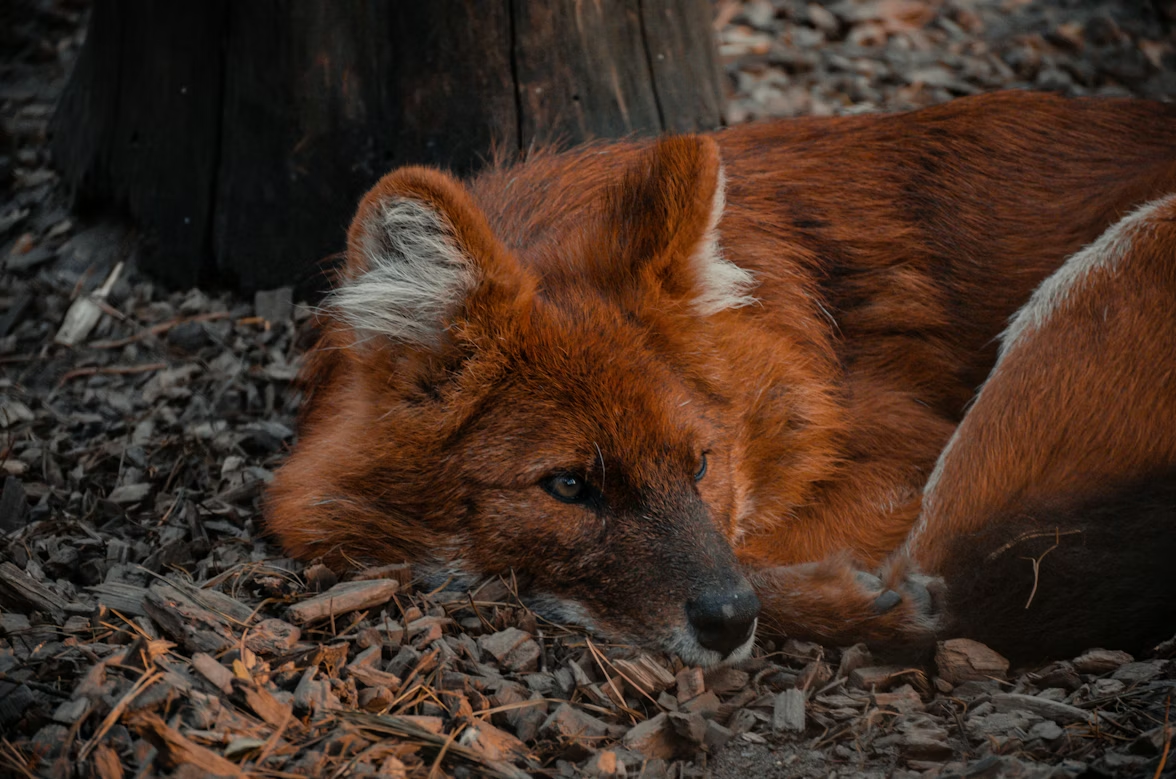
Another animal that is endangered by humans is the Red Wolf. Red wolves are the most endangered species of wolves and have a long history of human-caused harm. Statistics show that “during 2014-2018, poaching was a major cause of increased extinction rates of the wolves, and by 2020, there were about 15 Red Wolves recorded to be alive in the world” (U.S Fish and Wildlife Service). However, progress is being made. In recent years, Red Wolves have been reproducing new litters, and the U.S Fish and Wildlife Service has been protecting and working to bring back a healthy amount of the population.
The fatal deterioration of endangered species shows how our actions are having dangerous consequences. If we continue to neglect our role in animal endangerment, it could lead to the death of thousands of species. For example, if we neglect the protection of marine life like the Vaquita, we could lose a species that has inhabited our oceans for millions of years. If we shift our focus to the Red Wolves, recent years have shown us litters of them spreading because of protections from poaching (Natural Sciences). The population rebound of Red Wolves shows a sign of hope that we can fix the problem we caused and lead to the comeback of endangered species. Statistics show a recent rapid decline in species, which is around 48,600, telling us that many are close to extinction. The world will not get better if we don’t make a change happen. We can prevent animal extinction by supporting organizations, protecting endangered species, volunteering, recycling, decreasing pollution rates, conserving Earth's waterways, and reducing chemical use that damages natural environments. All of these efforts will hopefully create an Earth where humans live in harmony with the natural world, not destroy it.
header image used under the Unsplash License
Works Cited:
IUCN Red List of Threatened Species, http://iucnredlist.org.
Gittleman, John L., and Anna Dubey. “Extinction | Definition & Examples.” Britannica, 11 April 2026, https://www.britannica.com/science/extinction-biology.
“Gulf of Mexico Gillnet Fishery - MMPA List of Fisheries.” NOAA Fisheries, https://www.fisheries.noaa.gov/national/marine-mammal-protection/gulf-mexico-gillnet-fishery-mmpa-list-fisheries.
“Living Planet Report 2024.” Home | WWF, https://livingplanet.panda.org/en-US/.
Pimm, Stuart L. “Estimating the normal background rate of species extinction.” PubMed, 26 August 2014, https://pubmed.ncbi.nlm.nih.gov/25159086/.
“Red Wolf (Canis rufus) | U.S. Fish & Wildlife Service.” U.S. Fish and Wildlife Service, https://www.fws.gov/species/red-wolf-canis-rufus.
“Red Wolves Shown To Have Ecological Value, Even As Species Fell Towards Extinction.” National Sciences, https://naturalsciences.org/calendar/news/red-wolves-shown-to-have-ecological-value-even-as-species-fell-towards-extinction/.
“Set Gillnets.” Seaturtles, https://seaturtles.org/action-set-gillnets/set-gillnets/.
“Vaquita Porpoise – National Marine Mammal Foundation.” National Marine Mammal Foundation, https://nmmf.org/marine-mammals/vaquita-porpoise/.
“What is killing the vaquita? — Porpoise Conservation Society.” Porpoise Conservation Society, https://porpoise.org/knowledge-base/what-is-killing-the-vaquita/.
“Why do animals and plants become endangered? | U.S. Geological Survey.” USGS.gov, https://www.usgs.gov/faqs/why-do-animals-and-plants-become-endangered.
“WWF LPR: Wildlife Populations Down 73% Since 1970.” World Wildlife Fund, 9 October 2024, https://www.worldwildlife.org/news/press-releases/catastrophic-73-decline-in-the-average-size-of-global-wildlife-populations-in-just-50-years-reveals-a-system-in-peril/.

 The Benefits Of Running: How Running Can Be Rewarding to Your Brain and Body